

365-day money-back promise  ·  Instant download  ·  Not ready to buy? Read a chapter free →
Kognitive Kittens

$7 ยท instant download

You’ve been ‘fine’ for years. Here’s the map out.

An illustrated guide to the four stages between running on fumes and feeling like yourself again. Find the stage you’re in tonight, and see what the next one looks like.

Instant PDF downloadRead it tonight on your phone365-day money-back promise

From Survival to Feeling Safe
A kitten reading by a sunny window

The most capable person in the room is often the most tired

You handle things. You plan for the worst so nobody else has to. You answer messages within minutes, you remember everyone’s birthday, and when someone asks how you are, you say ‘fine’ before they’ve finished the question.

From the outside it looks like strength. From the inside it feels like holding your breath for years.

Survival mode is what a nervous system does when it decides life isn’t safe. It’s clever and protective, and it was never meant to be permanent.

Sound familiar?

The patients who kept dropping out

People call you strong. You’ve heard it so often that it has started to sound like a job description.

In the mid-1980s Vincent Felitti ran an obesity program at Kaiser Permanente in San Diego. Some of his most successful patients, people who had lost a great deal of weight, kept dropping out and gaining it back. When he finally sat down and asked them why, many told him about abuse in childhood. One woman said the weight made her feel safe, because being overlooked was the point.

To her, the weight was the answer to a much older problem, and it was still doing its job. Those conversations grew into the Adverse Childhood Experiences study, which surveyed more than 17,000 adults and changed how medicine thinks about childhood. Survival strategies work like that. Hyper-independence, people-pleasing, never stopping: each one solved something once. They’re also why you’re so tired.

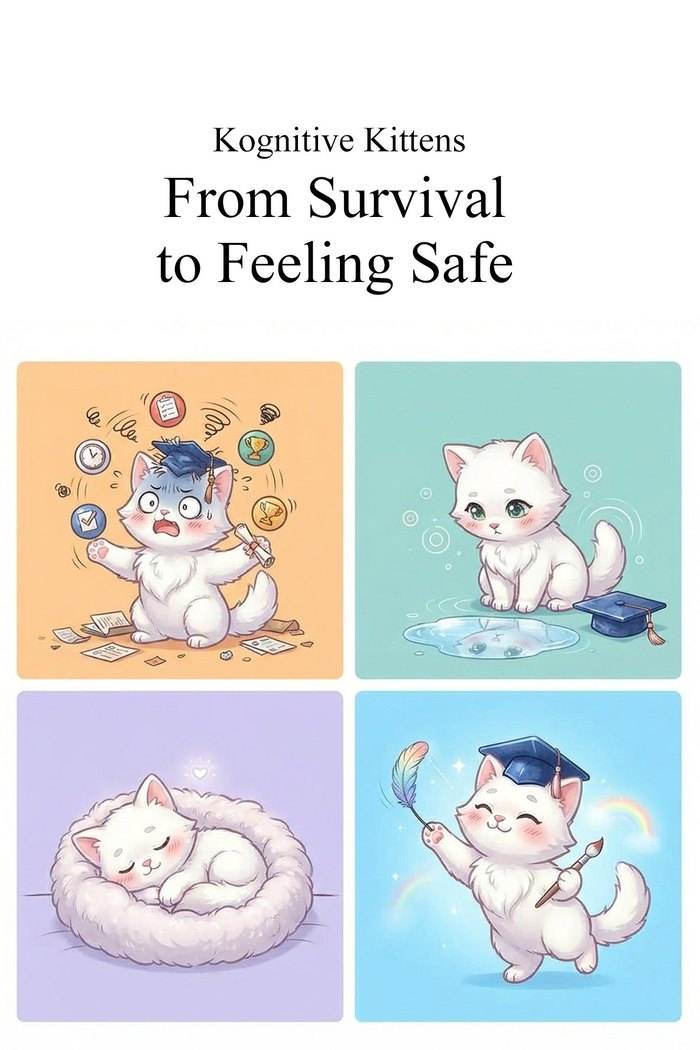
The map shows the way out in four stages, with the signs for each, so you can find where you are and see what comes next.


Inside the $7 map

Find where you are

Getting out of survival mode happens in four stages. Each one has its own signs, and its own next step.

1. Survival Mode

You’re fine. You’re always fine. You do it all yourself, plan for the worst, stay busy, and your mind never stops, even when your body finally does.

2. Awareness

You start catching it: the trigger, the pattern, the moment before you say yes. You still do the thing sometimes, but now you see it, and you go easier on yourself for it.

3. Regulation

Your body stops bracing. You say no without a four-paragraph apology. You rest without earning it first. You trust your own read on things.

4. Feeling Safe

More energy, fewer 3am meetings, relationships that don’t cost you everything, room to make things again. You feel like yourself, the one from before you got so good at coping.

A white kitten waving happily by a sunny window

The center of the map

What it’s like on the other side

It’s a Tuesday. Nothing special. Someone asks if you can take on one more thing, and you say, ‘I can’t this week.’ Then you don’t write three more sentences explaining why.

You still have bad nights, but the 3am meetings got rarer, and when one starts you know what it is. It doesn’t get the whole night anymore.

Your mom calls, worried about the neighbor’s fence, and you hang up still feeling like yourself. At nine o’clock you sit on the couch and do nothing, and you don’t feel behind.

From the outside, nobody would notice much. You’d notice it everywhere.

That’s stage four, Feeling Safe. The map shows you the three stages before it, and where you are right now.

Before you decide

What’s probably stopping you

“I’ve read self-help before. Nothing changed.”

Most advice is written for someone further along than you. Breathing exercises and boundary scripts are tools for stage three. Try them in stage one, while your body still thinks it’s under attack, and they slide right off, and you decide you’re the problem. The map starts with where you are.

“I don’t have the energy for another project.”

It’s an illustrated guide, made to be read on the couch at the end of a long day. You can find your stage before bed. Nothing else is asked of you this week.

“I’m not falling apart. I’m functioning.”

Survival mode looks like functioning. The people in it are usually the most reliable people in the room: organized, capable, fine. You can run like that for years. The question is what it costs you, and whether you’d like to stop paying.

“I don’t want to dig through my whole childhood.”

You don’t have to. The map is about where you are now and what comes next. If you ever want the why, the books go there. You don’t need them to start.

Why it’s $7

Because the first step out shouldn’t need a budget meeting. Keep it on your phone. Print it for the fridge. Look at it on the days you forget how far you’ve come.

From Survival to Feeling Safe

Your first step out

From Survival to Feeling Safe

$7

  • Four stages out of survival mode, illustrated
  • The signs for each stage, so you can find yours
  • PDF, on your phone the moment you pay

365-day money-back promise. Read it for a year. If it didn’t help, you get every cent back. No questions asked.

A kitten watering a seedling in a pot

Not ready to spend anything?

You’re not too set in your ways. Here’s the brain scan that proves it.

London cab drivers memorize around 25,000 streets to get their license. When the neuroscientist Eleanor Maguire scanned their brains in 2000, the region that handles spatial memory had grown, and it was bigger the longer they’d been driving. Grown adults, reshaped by practice.

Chapter 21 explains how that works, and what it means for the patterns you’d like to drop. It’s free.

Free. You’ll only need your email address, so we know where to send it.

Want the science behind every stage? Book III covers stress, survival mode, anxiety and burnout in depth.

You can’t lose here

Read it for a whole year.

Change takes longer than a refund window usually allows, so ours is a year long. If at any point in the next 365 days you decide it didn’t help, email us at [email protected] and we’ll refund you in full. You don’t have to explain.

We’d rather you take a year to decide than not start at all.

Still wondering?

What exactly do I get?

A PDF you can download the moment you pay. Read it on your phone, tablet, laptop or e-reader, or print it at home. Bundles and the complete set include every book in them.

When does it arrive?

Immediately. Payhip shows you the download link on screen and emails it to you as well.

Do I have to read the books in order?

No. Each book works on its own, so start wherever it hurts most.

What if it doesn’t help?

You get your money back. You have 365 days: email us at [email protected] and we’ll refund you in full. No questions asked.

Is this only for women?

No. A nervous system is a nervous system. The examples lean toward the women we hear from most, and Book VI ends with a chapter on women’s hormonal health, but the rest applies to anyone with a body and a past.

Is this therapy?

No. It explains what’s going on inside you, so that everything else you try, therapy included, has something solid to stand on. If you’re in therapy already, bring it to your next session. If you’re struggling badly, please talk to a professional too.

These books are education, written to help you understand yourself. They don’t replace a doctor, therapist or crisis line. If you’re in danger or thinking about harming yourself, please contact your local emergency number or a crisis line right now.

Find where you areGet the map · $7