365-day money-back promise  ·  Instant download  ·  Not ready to buy? Read a chapter free →
Kognitive Kittens

If you’re tired in a way sleep doesn’t fix

For the one who’s always fine, and always tired.

You answer texts in twelve seconds. You rehearse a three-word email for forty minutes. At 3am your brain calls a meeting and you attend. That’s survival mode, and there’s a way out of it. This $7 illustrated guide shows you which stage you’re in, and what the next one looks like.

Instant PDF downloadRead it tonight on your phone365-day money-back promise

From Survival to Feeling Safe, the $7 illustrated guide

Be honest

Tap every line that sounds like you.

Tap the ones that fit. Nobody’s watching.

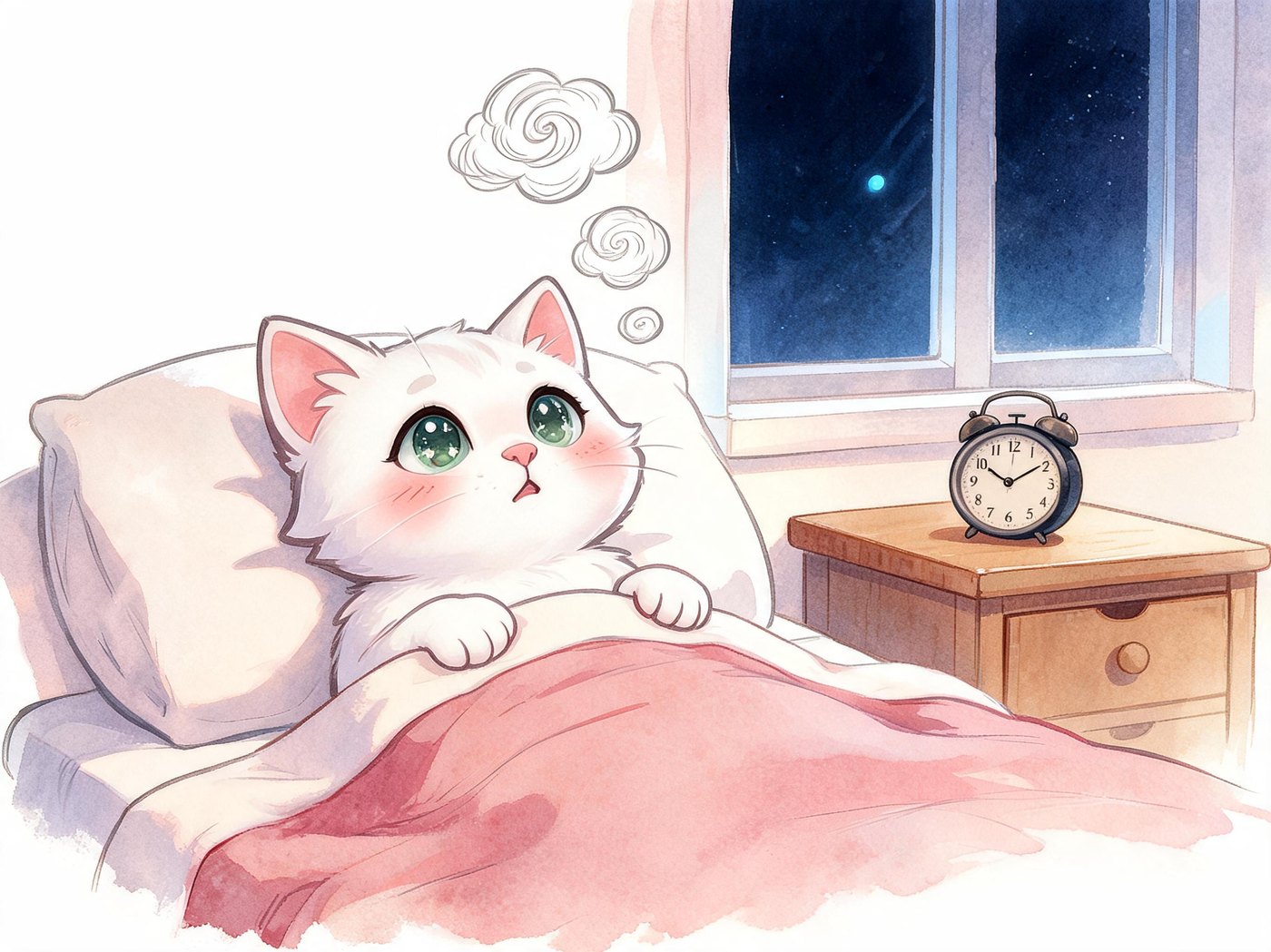
A kitten lying awake in bed at night, a clock on the bedside table

Your brain has called a meeting. You’re the only one who came.

On the agenda: something you said in 2014, tomorrow’s email, and whether everyone is secretly annoyed with you. There’s a reason it happens at night, and it was first spotted in a Berlin restaurant a hundred years ago.

Thirty open orders

It’s 3:04. You’re not worried about anything in particular. You’re worried about everything a little: the email you haven’t answered, the thing you said at dinner, the appointment you keep meaning to book, whether your sister sounded off on the phone.

In the 1920s a young psychologist named Bluma Zeigarnik sat in a Berlin restaurant with her teacher, Kurt Lewin, and watched a waiter take a big table’s order without writing anything down. Every dish, every seat, perfect. After the bill was paid, they asked him to repeat it. He couldn’t. The whole order was gone.

Zeigarnik spent years testing what she’d seen, and it held: the brain keeps unfinished business lit up and lets finished business go. That’s your 3am. Every open loop in your life is an order your brain is still holding, and it doesn’t care that you’d like to sleep.

Lists help. But if the loops reopen every night however many lists you write, your stress system has been on for so long that it treats every open loop as a threat. That’s survival mode, and the way out of it has four stages. The $7 map shows you which one you’re standing in.


Inside the $7 map

Find where you are

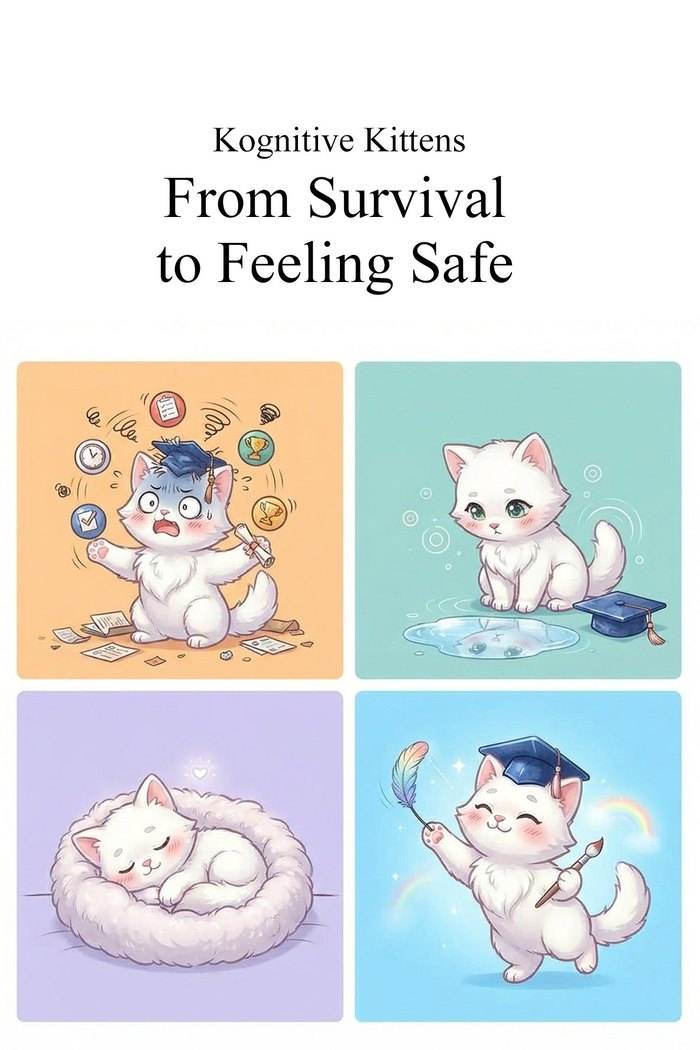
Getting out of survival mode happens in four stages. Each one has its own signs, and its own next step.

1. Survival Mode

You’re fine. You’re always fine. You do it all yourself, plan for the worst, stay busy, and your mind never stops, even when your body finally does.

2. Awareness

You start catching it: the trigger, the pattern, the moment before you say yes. You still do the thing sometimes, but now you see it, and you go easier on yourself for it.

3. Regulation

Your body stops bracing. You say no without a four-paragraph apology. You rest without earning it first. You trust your own read on things.

4. Feeling Safe

More energy, fewer 3am meetings, relationships that don’t cost you everything, room to make things again. You feel like yourself, the one from before you got so good at coping.

A white kitten waving happily by a sunny window

The center of the map

What it’s like on the other side

It’s a Tuesday. Nothing special. Someone asks if you can take on one more thing, and you say, ‘I can’t this week.’ Then you don’t write three more sentences explaining why.

You still have bad nights, but the 3am meetings got rarer, and when one starts you know what it is. It doesn’t get the whole night anymore.

Your mom calls, worried about the neighbor’s fence, and you hang up still feeling like yourself. At nine o’clock you sit on the couch and do nothing, and you don’t feel behind.

From the outside, nobody would notice much. You’d notice it everywhere.

That’s stage four, Feeling Safe. The map shows you the three stages before it, and where you are right now.

Before you decide

What’s probably stopping you

“I’ve read self-help before. Nothing changed.”

Most advice is written for someone further along than you. Breathing exercises and boundary scripts are tools for stage three. Try them in stage one, while your body still thinks it’s under attack, and they slide right off, and you decide you’re the problem. The map starts with where you are.

“I don’t have the energy for another project.”

It’s an illustrated guide, made to be read on the couch at the end of a long day. You can find your stage before bed. Nothing else is asked of you this week.

“I’m not falling apart. I’m functioning.”

Survival mode looks like functioning. The people in it are usually the most reliable people in the room: organized, capable, fine. You can run like that for years. The question is what it costs you, and whether you’d like to stop paying.

“I don’t want to dig through my whole childhood.”

You don’t have to. The map is about where you are now and what comes next. If you ever want the why, the books go there. You don’t need them to start.

A kitten watering a seedling in a pot

Not ready to spend anything?

You’re not too set in your ways. Here’s the brain scan that proves it.

London cab drivers memorize around 25,000 streets to get their license. When the neuroscientist Eleanor Maguire scanned their brains in 2000, the region that handles spatial memory had grown, and it was bigger the longer they’d been driving. Grown adults, reshaped by practice.

Chapter 21 explains how that works, and what it means for the patterns you’d like to drop. It’s free.

Free. You’ll only need your email address, so we know where to send it.

You can’t lose here

Read it for a whole year.

Change takes longer than a refund window usually allows, so ours is a year long. If at any point in the next 365 days you decide it didn’t help, email us at contact email and we’ll refund you in full. You don’t have to explain.

We’d rather you take a year to decide than not start at all.

Still wondering?

What exactly do I get?

A PDF you can download the moment you pay. Read it on your phone, tablet, laptop or e-reader, or print it at home. Bundles and the complete set include every book in them.

When does it arrive?

Immediately. Payhip shows you the download link on screen and emails it to you as well.

Do I have to read the books in order?

No. Each book works on its own, so start wherever it hurts most.

What if it doesn’t help?

You get your money back. You have 365 days: email us at contact email and we’ll refund you in full. No questions asked.

Is this only for women?

No. A nervous system is a nervous system. The examples lean toward the women we hear from most, and Book VI ends with a chapter on women’s hormonal health, but the rest applies to anyone with a body and a past.

Is this therapy?

No. It explains what’s going on inside you, so that everything else you try, therapy included, has something solid to stand on. If you’re in therapy already, bring it to your next session. If you’re struggling badly, please talk to a professional too.

These books are education, written to help you understand yourself. They don’t replace a doctor, therapist or crisis line. If you’re in danger or thinking about harming yourself, please contact your local emergency number or a crisis line right now.

Find where you areGet the map · $7